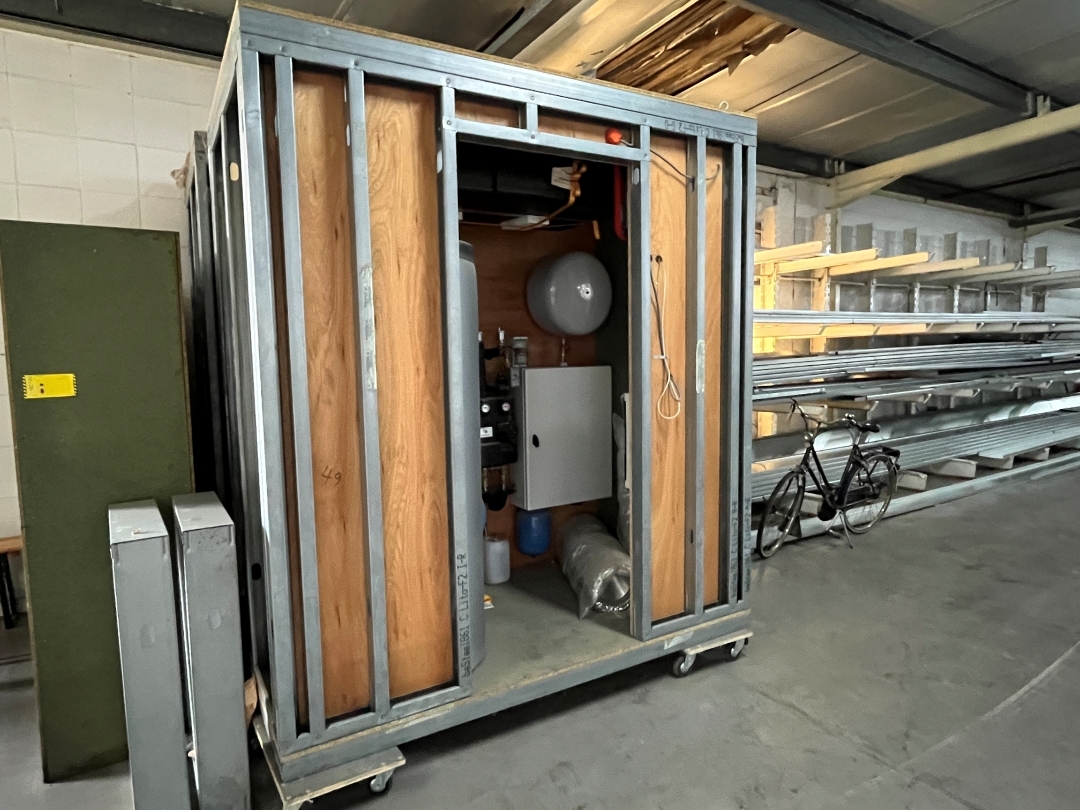
They are an undeniable presence in every home and commercial building: building systems. Whether they are plumbing, electrical, IT, or HVAC systems, the role of technology in our environment has increased dramatically in recent decades. An industrial, prefabricated approach to these systems is still in its infancy in this sector. BIM4Production® also helps installation companies achieve their goals in scaling up the prefabricated production of system cabinets, cable harnesses, or HVAC systems. When industrializing this production, there are four developments to take into account. I’d be happy to tell you what they are and how BIM4Production® can help you with them.
1. Manufacturing in Sequence
The degree of prefabrication depends on the installation technique. The specific “component” of the installation is also relevant. The meter cabinet or “wet room” (bathroom) can be installed relatively more quickly in a prefabricated production process than a wiring harness that is routed in a specific way within a prefabricated module. Based on the installation concept and the BIM model, it is important to know which components are placed where and where the connections (connection points) are located. In addition, it is also important to pay attention to the logistical processing in the prefabrication chain. For example: having the correct prefab cable harness for the correct prefab living unit arranged in the proper order on the transport cart.
Because each element has a unique position in BIM4Production®, all element details can be quickly accessed—not only during production but also years after installation. Each element is linked to a document library that includes, among other things, the engineering specifications and the 3D and 2D drawings. This way, employees know exactly where and which technical connection points are required.
2. Application and Use of Materials and Components
A hallmark of installation engineering is the use of many (sub)materials. Any given installation consists of a combination of various “components” from an equally diverse range of manufacturers and suppliers. In terms of liability, it is becoming increasingly important to have a clear understanding of the composition of the technical solutions provided for delivery, maintenance, and service purposes.
BIM4Production® displays a “list” of the components used for each element as soon as you scan the unique element code. This includes 2D drawings and, when automation permits, the supply chain as well.
3. Ensuring Quality
In the Netherlands, we set high standards for the safety of installations. These are laid out in various standards, laws, and regulations. The quality assurance process begins during the design phase of installations. These guidelines must be continuously monitored throughout the prefabrication process. Complying with them often takes a lot of time and places high demands on your staff.
BIM4Production® assists in this process, for example, with the element app. During the design phase, each element is assigned a unique QR code or RFID tag. Any employee can scan this code to then complete checklists and add photos via a smartphone or tablet. This makes it possible to quickly and transparently demonstrate at a later stage that everything was manufactured, delivered, and installed in the prefabrication environment in accordance with current regulations.
4. Flexibility and Dismantlability of Systems
From the perspective of sustainable maintenance and renovation, there is a growing focus on demountable construction. This also applies to prefabricated systems, such as plug-in systems or climate control units mounted on the exterior facade of a building. It is therefore important to know where the connection and disconnection points for this technology are located.
Because each element has a unique position in BIM4Production®, all element details can be quickly accessed—not only during production, but also years after installation. Each element is linked to a document library that includes, among other things, the engineering documentation and the 3D and 2D drawings. This way, employees know exactly where the connection and disconnection points are within the element.
View the LinkedIn postBIM4Production®: Ensuring optimal flow.
7463 PJ Rijssen
VAT: NL811764916B01