Prefab on the Move: Toward Digital and Automated Production
A vision for the future of prefab construction and installation in the Netherlands, with concrete guidelines for prefab builders.
The prefab construction sector in the Netherlands is at a turning point. The demand for affordable, sustainable, and quickly built homes and buildings has never been greater. At the same time, social, technological, and political developments are forcing construction companies to rethink their business operations. Digitalization and automation are no longer a luxury but an absolute necessity for surviving and growing amid these market developments. In this opinion piece, I’ll walk you through some of the most important trends and challenges and offer prefab builders a forward-looking vision—complete with practical recommendations.
Prefabrication in the Context of the Netherlands (and Beyond)
The Netherlands is aging and becoming increasingly urbanized. Rising population growth is driving demand for more single-person households and flexible live-work solutions. This is putting pressure on the housing market and commercial real estate. Prefabrication offers a solution here: fast, scalable production of homes or home components that align with changing living and working needs—in both new construction and renovation. Outside the Netherlands, we see similar trends, for example in Germany, England, and Scandinavia. In Scandinavia in particular, prefabrication has long been commonplace. These are various developments that serve as drivers behind the demand for innovative, modular solutions that can be rapidly deployed in both urban and rural areas. In the Netherlands and beyond.
The construction sector in the Netherlands is sensitive to economic cycles, inflation, and, increasingly, shortages of materials and labor. Prefabrication turns these challenges on their head by using raw materials more efficiently and by applying available knowledge and expertise in ways that differ from traditional construction.
Social Influences
Societally, acceptance of prefab as a fully-fledged construction method is growing. Old prejudices (“prefab construction is run-of-the-mill, cold, and impersonal”) are giving way to an appreciation of quality, sustainability, and speed. We are seeing a shift in expectations. Clients want customization, comfort, and a healthy living and working environment—all within the (political) constraints and spatial limitations of a village, city, or rural area.
This calls for a smart and thoughtful approach to available space and raw materials, whether in single-family homes, high-rise buildings, or rooftop additions. These are expectations and requirements that prefab manufacturers are increasingly able to meet thanks to digital design and production processes.
The labor market is also changing: young talent is seeking meaningful work, innovation, and digital tools. Whereas traditional construction was—and perhaps still is—primarily a physically demanding, male-dominated field, prefab construction, precisely because of digitization and automation, offers opportunities for women. Prefab manufacturers that embrace a modern and contemporary corporate culture attract the professionals of tomorrow.
Technological and Economic Influences
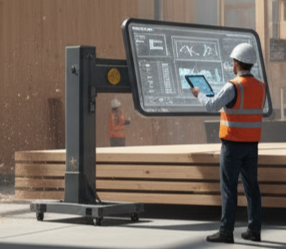
Technological innovation and applications are the driving force behind the prefab industry. The possibilities are growing by the day—from BIM (Building Information Modeling) to robotization, and perhaps closer than we think: 3D printing and AI-driven production. Digital twins (virtual factories) make it possible to optimize entire homes and buildings before a single panel has even been produced.
It is important to view the entire chain—from additional demand through production, delivery, and assembly—as a single digital (highway). This applies not only within your own factory but also across collaborating prefab factories. The transition from BIM (Building Information Modeling), BIM2 (Building Information Management), and BIM3 (Building Integration Modeling) to BIM4 (Building Integration Management) is an undeniable digital transformation. Digital supply chain collaboration is a prerequisite for this.
Digitization and automation make it possible to optimize production processes, reduce failure costs, and respond more quickly to market changes. At the same time, the transition to an automated factory requires substantial investments and a shift in business operations. Automation of design, planning, production, quality assurance, and logistics leads to unprecedented acceleration and quality improvements. Those who embrace these technologies can deliver standardized, customized solutions at a competitive price. Those who invest now will reap the benefits later.
Environmental Factors
Prefabricated construction offers opportunities in the areas of circularity, energy efficiency, and minimizing construction waste. The use of bio-based materials in prefabricated construction is also on the rise. Sustainability in construction and installation is no longer merely an option but a strict prerequisite.
By manufacturing in a controlled environment, materials can be utilized optimally, and reuse is easier to organize. Digitalization also helps make environmental performance measurable and improves it. And because production data is available digitally, this will also contribute positively to the demountability and reuse of these “raw materials in shape.” The construction sector’s ecological footprint can be significantly reduced now and in the future—a necessity in light of climate goals and stricter regulations.
Digitization and Automation: Trends, Opportunities, and Challenges
In the prefab factory, digitization and automation are increasingly becoming the backbone of the future-proof factory. Seamless collaboration between design, engineering, and production should no longer be in question. An efficient transition from the engineering to the production domain (automated production lines for sawing, drilling, assembling, finishing, etc.) is a requirement. As a prefab manufacturer, you want smart monitoring of processes, machines, and logistics. And you want to use all the data you generate or receive from these systems to optimize production planning, production, and inventory management, while reducing failure costs.
The opportunities are endless: higher quality, lower costs, fewer errors, shorter lead times, and greater customer satisfaction. But there are also challenges. Digitization and automation require investments—both financial and in a shift in mindset that makes room for different, new skills. Legacy systems must be integrated with new technologies. Finally—and this is perhaps the greatest challenge—how do you get (all) employees on board right away? Is there sufficient resources to invest in training and change management?
Digital Prefab: Impact on Business Operations
Digitizing and automating a prefab factory usually also entails significant changes in business operations. Processes are standardized and digitized, resulting in fewer manual tasks and less room for error. Roles are shifting from physical to digital: from carpenter to operator, from draftsman to BIM modeler, from site supervisor to data analyst. Organizational structures become flatter and more flexible, with a greater emphasis on multidisciplinary collaboration. This requires new skills, ranging from customer focus to project management and digital communication. The prefab builder of the future is a high-tech service provider.
A Prefab Vision for the Future
Prefabrication is becoming the norm in the Dutch construction sector—for both new construction and renovations. Prefab manufacturers produce and deliver “elements” on an industrial scale—ranging from window frames and bathroom units to complete homes or buildings, including both single-family homes and high-rise structures. This addresses the ongoing demand for homes and commercial buildings. In prefabrication, production is automated, circular, and carbon-neutral. Customers design their homes online, after which the design is sent directly (digitally) to the factory. Construction sites serve as logistics hubs where components and modules are assembled in a matter of days in such a way that they can later be disassembled and reused—both in the Netherlands and abroad. Prefab companies are becoming data-driven organizations. Digitization and automation make it possible to respond quickly to developments. Do we, as the Netherlands, dare to strive for international recognition as a leader in industrial, circular construction?
Overcoming initial hesitation: prefab is gaining momentum
The future of prefab construction in the Netherlands is digital, automated, and sustainable. Its importance is undeniably great and offers the industry many (market) opportunities, both nationally and internationally. The time for waiting and seeing, for “keeping up appearances,” and for hesitation is over. But what concrete steps should be taken?
Identify which processes (design, production, logistics) in your factory can be digitized or automated. Ensure your employees can adapt to the digital transition. Think big, start small: begin with a single pilot project (such as an automated production line) and let the lessons learned drive further expansion. Collaborate with technology partners, research institutions, and other prefab companies to share knowledge and mitigate risks. Use data to continuously improve processes and reduce failure costs. Formulate a clear strategy for digitization and automation, with concrete goals and milestones.
Prefab builders who invest in digitization and automation now are building not only their own future but also that of the Netherlands. Take the first step today: assess your situation, innovate, and seek out partnerships. In short: get moving and get to work!
7463 PJ Rijssen
BTW: NL811764916B01